


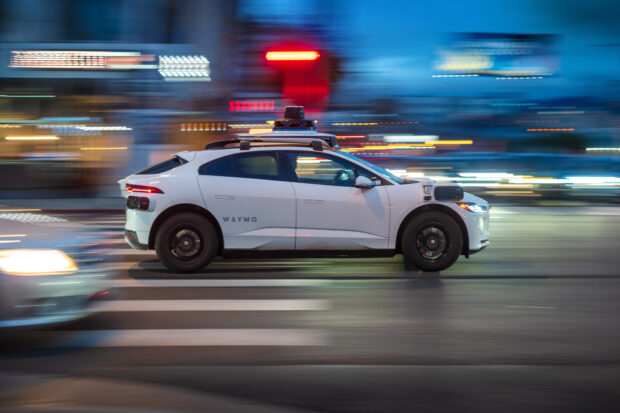
A new study shows that Waymo driverless cars are involved in fewer crashes than human drivers, but the federal system monitoring automated vehicles needs improvement, according to the Insurance Institute for Highway Safety (IIHS).
Per vehicle mile traveled (VMT), Waymo’s driverless vehicles deployed in San Francisco, Phoenix, Los Angeles and Austin were involved in 68% fewer crashes than human drivers, researchers found. The sample was restricted to crashes that a person would typically report to the police, the IIHS said.
“The results show that, on a limited scale, these driverless cars are safer than human drivers — who can be impaired or drowsy or suffer lapses in attention,” IIHS President David Harkey said. “However, the present data collection system isn’t good enough to allow continuous monitoring of a large-scale expansion.”
Started in 2009 as the Google self-driving car project, Waymo launched its driverless robotaxi service for the public in Phoenix in 2020, expanded to San Francisco in 2022 and Los Angeles in 2023, and began limited operation in Austin in 2024.
Its vehicles are classified as Level 4 on the automation scale created by SAE International, which means the automation can do all the driving with no human supervision under certain conditions.
In contrast, the Level 2 partial automation systems widely available for purchase by the general public, such as General Motors’ SuperCruise or Ford’s BlueCruise, require a human driver to remain alert and ready to take over at all times. Those systems involve different risks, according to the IIHS, including that the monotony of supervision can lead to attention fatigue, and many drivers put too much trust in the technology.
Level 3 systems can operate without constant human supervision in specified conditions, but a human still needs to be in the driver’s seat and ready to intervene when requested. Vehicles with such systems are very rare. Level 5 vehicles, capable of driving without human input under all conditions, don’t exist yet.
Since 2014, California has required companies testing self-driving cars on public roads to report crash involvements that result in fatalities, injuries, or property damage of any amount.
The National Highway Traffic Safety Administration (NHTSA) began requiring similar reporting in 2021 under a Standing General Order (SGO) on crash reporting for incidents involving automated driving systems.
Though the SGO database was primarily intended to track defects and enforce recalls, it is the only national data collection tool for crashes involving self-driving vehicles, according to the IIHS. It is a key resource for safety research, but neither it nor the California database makes it easy to compare the crash rates of Level 4 vehicles with those of human drivers.
While companies are required to report crashes, they are not obligated to report the miles they log or whether the miles involved a human driver. Waymo provides driverless VMT information voluntarily, but other companies do not. That makes it impossible to know how common it is for their vehicles to crash, the research body said.
Even with the mileage data that Waymo provides, a direct comparison with crash rates of human drivers is impossible without time-consuming operations to account for differences between the reports required by the SGO and what humans report, the IIHS researchers found.
Human drivers are generally only required to report crashes that cause an injury or result in more than $1,000 in property damage, though the damage threshold varies by state. Many drivers also opt not to report crashes that meet the reporting threshold to avoid an increase in their insurance premiums or for other reasons. Around half of all crashes and a third of injury crashes go unreported, according to IIHS.
In contrast, until an amendment to the SGO that took effect in 2025, self-driving vehicle companies were required to log minor incidents as crashes. For example, a vehicle scraping its undercarriage while turning into a parking lot would count as a crash. Though property-damage thresholds are now more closely aligned, companies are still more likely than regular people to report all qualifying crashes due to the business risks of failing to comply with the regulation, the IIHS said. In addition, driverless vehicles require expensive sensors that can be damaged by minor impacts, making their crashes more likely to exceed the damage threshold.
For a realistic comparison of crash rates, IIHS researchers had to clean up data from crash reports submitted to NHTSA by Cruise, Waymo, Zoox and others from 2021 to 2024.
The first step was to cull hundreds of redundant records, then eliminate certain incidents. These included situations in which the automation wasn’t engaged, the vehicle wasn’t on a public road, or no real crash took place. The process eliminated about a quarter of the reported crashes.
The next step was to determine whether the incident was severe enough that a reasonable person would have reported it to the police. The researchers made this determination based on the nature of the impact and property damage, the types of injuries reported, and other factors. For example, if a person complained of pain but left the scene, the researchers coded that crash as unlikely to be reported to the police. If an airbag deployed, they coded that crash as police-reportable due to the higher impact speed and the cost of airbag replacement — regardless of other property damage or injury.
Using that common-sense standard, they estimated that only 22% of the 736 public-road crashes in which the automation was engaged were likely police-reportable — 89 crashes involving Waymo vehicles, 50 involving Cruise vehicles, 10 involving Zoox vehicles and 10 involving other companies.
Because mileage data were only available for Waymo, IIHS researchers used its crashes to calculate self-driving vehicle crash rates. Of Waymo’s 89 police-reportable crash involvements, 64 were in driverless operation, and the others involved supervised use of the automation.
Waymo vehicles traveled about 50 million miles in driverless operation over the study period, compared with about 222 billion miles by human drivers over the same period and in the same locations. Overall, Waymo’s crash involvement rate was 68% lower than that of human drivers — 76% lower in Phoenix, 35% lower in San Francisco, 71% lower in Los Angeles, and 4% higher in Austin, where the sample size was relatively small.
Waymo vehicles were involved in 85% fewer single-vehicle crashes and 81% fewer injury crashes per VMT than human drivers.
“Those are encouraging signs for the future of driverless vehicles,” said Eric Teoh, IIHS director of statistical services and lead author of the study. “Now we need to get the data collection system right, so that we can ensure that level of safety continues as these technologies become more prevalent.”
 Tech Bytes: New Partnerships at The Zebra, LexisNexis Risk Solutions
  AI Agents’ Access to Personal Information Raises Privacy Concerns
  LA Fire Victims Set to Lose Case Managers Due to Standoff Between California, FEMA
  Viewpoint: The ‘Unbundled’ Insurer Emerges in Age of AI as Value Chain Fragments